



Healthy Bowel Movements: What’s Normal and When to Take Action
Talking about bowel habits isn’t easy, but avoiding the topic can mean missing important signs about your health. Many people feel embarrassed to think about how often they have a bowel movement, yet changes in your usual pattern can be one of the earliest indicators that something needs attention. Understanding what’s normal — and when to take action — can help you stay comfortable, confident, and in control of your digestive health.
How often should you go?
Everyone’s digestive system is different. For healthy adults, normal bowel frequency can range from three times a week to three times a day. Factors such as diet, metabolism, activity level, and biological sex all influence what “normal” looks like for you. Because of this natural variation, there’s no single number everyone should aim for. What matters most is your personal routine.
If you usually go ten times a week and suddenly drop to three, that shift may suggest constipation or another underlying issue. Constipation is often overlooked simply because people don’t like to talk about it, but recognising changes early can help prevent discomfort and support long‑term gut health. When you notice a sudden change, consider your diet, hydration, stress levels, and activity. If constipation is painful or persistent, it’s important to seek advice from a healthcare professional.
What does a healthy bowel movement look like?
Frequency is only one part of the picture. The appearance of your stool also provides valuable information. The Bristol Stool Scale is a helpful guide:
- Smooth, soft, sausage‑shaped stools are generally considered healthy.
- Hard, small lumps or very bumpy stools often indicate constipation.
- Loose or watery stools suggest diarrhoea, which may require dietary adjustments or medical advice if ongoing.
If you experience involuntary bowel movements or difficulty controlling your bowels, speak with your GP. Incontinence products can support comfort and dignity, but they should not replace medical assessment when new symptoms arise.
How to Maintain Healthy Bowel Movements
Supporting your digestive health doesn’t need to be complicated. These evidence‑based habits can help keep your bowel movements regular and comfortable:
- Stay well hydrated: Aim for 1.5–2 litres of fluid daily.
- Eat enough fibre: Most adults benefit from 25–30g per day from fruits, vegetables, whole grains, pulses, nuts, and seeds.
- Keep physically active: Even 20–30 minutes of walking can support regularity.
- Establish a routine: Allow time for an unhurried toilet visit, ideally after meals.
- Don’t ignore the urge: Delaying bowel movements can contribute to constipation.
- Manage stress: Techniques like deep breathing or mindfulness can support gut comfort.
- Review medications: Some may affect bowel habits — speak with a healthcare professional if concerned.
- Seek medical advice when patterns change: Persistent constipation, diarrhoea, faecal incontinence and presence of blood should always be assessed by a GP.

Postnatal Bladder Weakness: Updated Overview and Evidence‑Based Guidance
Why Postnatal Bladder Weakness Happens
Postnatal bladder weakness is extremely common, affecting a significant proportion of women after childbirth. It typically results from weakening or injury to the pelvic floor muscles, connective tissues, or nerves during pregnancy or delivery. These structures support the bladder and urethra, and when compromised, they reduce the ability to control urine flow under pressure (e.g., coughing, lifting, laughing).
Pregnancy itself increases strain on the pelvic floor due to hormonal changes, increased abdominal pressure, and the weight of the growing uterus. Assisted delivery, prolonged labour, or perineal trauma, can further contribute to postpartum bladder dysfunction.
The good news: Postnatal bladder weakness is highly treatable, especially when addressed early with professional guidance. Women are encouraged to seek assessment from a GP, midwife, or pelvic health physiotherapist.
Exercise During Pregnancy
Regular physical activity during pregnancy is widely recognised as safe and beneficial for most women, provided they receive medical clearance. Exercise supports overall health, reduces pregnancy‑related discomforts, and prepares the body for labour and postpartum recovery.
Current guidelines highlight benefits such as:
- Reduced back pain, constipation, and swelling
- Improved energy levels and sleep quality
- Better mood and reduced anxiety
- Enhanced cardiovascular fitness
- Improved posture and muscular endurance
- Support for healthy gestational weight gain
- Potential reduction in labour duration
- Protection of pelvic floor function when exercises are chosen appropriately

Six Safe and Effective Exercises During Pregnancy
These activities are commonly recommended for pregnant women and can support pelvic health when performed correctly. Always consult a healthcare professional before beginning or modifying an exercise routine.
1. Brisk Walking
A low‑impact cardiovascular exercise that is gentle on joints and accessible to most women. It supports fitness without placing excessive strain on the pelvic floor. This can either be done around a local park or if you have access to a walking pad or a treadmill.
2. Light Dancing
Dancing at a comfortable intensity can improve cardiovascular health and mood. Avoid jumps, sudden twists, or high‑impact movements to protect pelvic stability.
3. Swimming
Swimming and water‑based exercise are considered among the safest and most effective prenatal activities. Water buoyancy reduces joint stress, supports the abdomen, and may ease back pain.

4. Prenatal Yoga
Yoga promotes flexibility, muscle strength, and relaxation. It also supports healthy blood pressure and reduces stress. Choose prenatal‑specific classes to ensure movements are safe.
5. Low‑Impact Aerobics
These classes improve cardiovascular fitness and muscle tone while minimising pelvic floor strain. Pregnancy‑specific classes ensure movements are adapted for safety.
6. Pelvic Floor (Kegel) Exercises
Pelvic floor muscle training is a first‑line treatment for both preventing and managing bladder weakness during and after pregnancy.
Guidelines recommend:
- Contract the pelvic floor muscles for 5 seconds, then relax for 5 seconds
- Perform 8–12 repetitions, 3 times daily
- Maintain normal breathing throughout
Pelvic health physiotherapists can provide personalised assessment and training programmes.
Important Safety Notes
- Stop exercising and seek medical advice if you experience pain, bleeding, dizziness, or unusual symptoms.
- Avoid high‑impact activities or heavy lifting unless cleared by a specialist.
- Postnatal bladder symptoms should be assessed early to prevent long‑term complications.
References
- Guideline for Intrapartum and Postpartum Bladder Care (2024).
- Norfolk & Norwich University Hospitals: Bladder Care and Fluid Balance, Antenatal, Intrapartum and Postnatal Guideline (2024).
- Royal College of Nursing – Bladder and Bowel Care in Childbirth (2024).

Preventing skin damage with incontinence: Dr. Claudio Pedone’s practical guidance
“Dermatitis is not just a minor irritation. It can lead to skin breakdown, infections, and real pain if we don’t act early.”
Did you know that skin problems are extremely common among people living with urinary incontinence? We spoke with Dr Claudio Pedone, geriatrician at the Fondazione Policlinico Universitario Campus Bio‑Medico in Rome, to understand why incontinence‑associated dermatitis is so often underestimated and what patients, caregivers, and healthcare professionals can do to prevent it. Here, he shares practical, experience‑based advice.

Understanding incontinence‑associated dermatitis
Fiona Ecarnot: “How common is IAD , and why is it such an important issue?”
Dr. Claudio Pedone:
“Incontinence‑associated dermatitis is very common. Recent data show that about one out of two people with urinary incontinence also have dermatitis.
The problem is that dermatitis adds an extra burden on top of incontinence itself. Patients report discomfort, irritation, and sometimes real pain. Beyond physical symptoms, it also affects self‑esteem and social interactions. So, it has a clear and significant impact on quality of life.”
Why dermatitis is often underestimated
Fiona Ecarnot: “Why do you think this condition is still not taken seriously enough?”
Dr. Claudio Pedone:
“Many people underestimate how severe dermatitis can become. It is often seen as ‘just redness,’ but it is not just erythema. Dermatitis can progress to skin breakdown and lead to infections, which can be very serious.
Education is essential for patients, caregivers, and healthcare professionals. We also need to address the stigma around urinary incontinence and the use of incontinence products, which often prevents people from speaking openly or seeking advice.”
Choosing the right incontinence product to protect skin health
Fiona Ecarnot: “What advice do you give patients when choosing an incontinence product to protect their skin?”
Dr. Claudio Pedone:
“The most important factor leading to dermatitis is maceration — prolonged exposure of the skin to moisture. That’s why effective absorption is key.
Urine needs to be absorbed quickly and locked away so it does not remain in contact with the skin. The speed of absorption really matters, especially in people who cannot communicate incontinence episodes, such as those with cognitive decline.
In those situations, having a highly effective absorbent product is essential for protecting skin integrity.”
Daily care: what patients and caregivers should do
Fiona Ecarnot: “What advice do you give to patients and untrained caregivers on maintaining skin integrity for someone with urinary incontinence?”
Dr. Claudio Pedone:
“Keeping the skin clean and dry is of the foremost importance. Good care should be consistent and preventive — not only reactive
Many caregivers are informal caregivers, often family members, and they may not fully realise that dermatitis is a serious issue. It is not simply something that comes with wearing absorbent products.”
Good care includes:
- Using an appropriate, effective incontinence product
- Changing products regularly to minimise moisture exposure
- Cleaning the skin gently after each episode
- Using mild, pH‑balanced cleansers
- Applying barrier products such as zinc oxide creams
“Skin should be checked regularly,” Dr. Pedone adds. “Redness or irritation can be an early sign of dermatitis. Acting early can prevent progression to more serious skin damage.”
When dermatitis is already present, professional medical advice is essential. Self-treatment without guidance can allow the problem to worsen.
The role of caregivers and the need for education
Fiona Ecarnot: “What challenges do you see when care is provided by family members?”
Dr. Claudio Pedone:
“Most caregivers are informal and untrained. They are doing their best, but they may not be aware that dermatitis is preventable and potentially serious.
Caregivers need to understand that prevention is fundamental, and that the right products and routines can make a very big difference. With better education, many cases of skin damage could be avoided.
The bigger picture: quality of life and stigma
Fiona Ecarnot: “What do you wish more people understood about the link between incontinence and skin health?”
Dr. Claudio Pedone:
“Dermatitis adds additional discomfort and pain to an already difficult condition. But beyond that, stigma plays a huge role. Many people suffer in silence.
Urinary incontinence does not define a person’s value or quality of life. When managed properly — with the right products, skincare, and support — people can continue living active lives, working, socialising, and maintaining their dignity.”
When preventive skin care should begin
Fiona Ecarnot: “When should skin care routines begin for people with urinary incontinence? Is it important to take preventive measures even before any visible irritation appears?”
Dr. Claudio Pedone:
“Preventive skincare should begin at the moment urinary incontinence is diagnosed. If there is a visible lesion, it’s already too late for prevention.
Management of urinary incontinence and protection of skin integrity must happen in parallel. Prevention always comes first. Treatment comes later — when prevention has failed.”
He also highlights the responsibility of healthcare professionals:
“Patients rarely disclose incontinence on their own. Active questioning is recommended by all guidelines. Making the diagnosis is the first preventive step in avoiding complications such as dermatitis.”
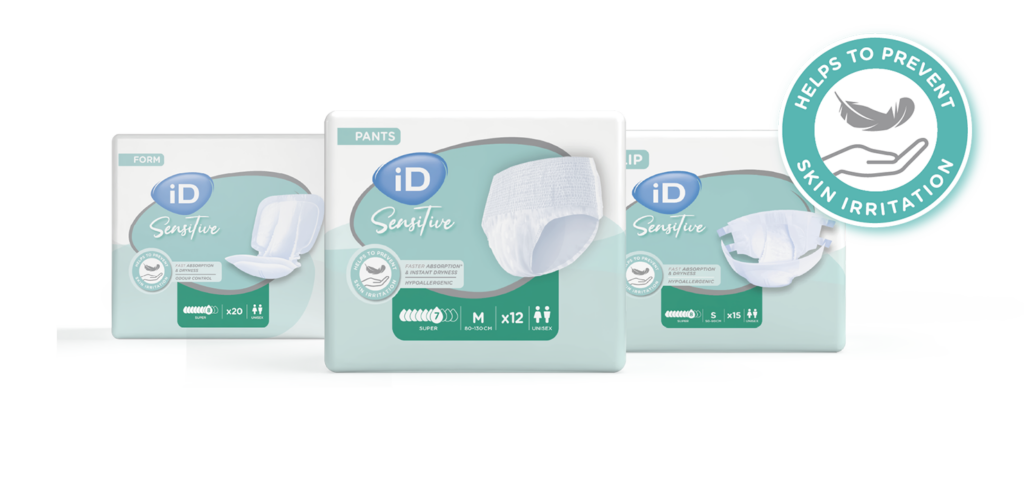
Meet our new iD Sensitive product range
Powerful protection, soft on skin
Designed for skin that helps to prevent irritation.

“A Lifeline for Carers”: Ontex supports unpaid carers
Overview
Part of Ontex' ongoing mission is to not only provide excellent quality products, but also to help provide education and training to all of our product users. One very important group are 'Unpaid Carers'. These are the people who are looking after their loved ones on a daily basis having no training and very little support for the work they do. This is why we have partnered with the Grace Cares charity to help provide this information on a local and national level.
Care Club met on Monday 26th January for another supportive session, welcoming unpaid care givers as the club continues to grow. Held in a safe environment, the session gives carers the opportunity to openly discuss their experiences, ask questions and share concerns, while being reassured that they are not alone.
The focus of the session was incontinence care, with practical advice delivered by an experienced incontinence nurse, Paulina Kurek alongside Michelle Garvey from Ontex. Attendees also received additional wellbeing support from Nicola Forsyth who shared guidance on managing stress and overwhelm through life coaching and effective breathwork techniques to help carers regulate and reset during challenging moments.

Care Club is organised by Grace Cares who are dedicated to supporting unpaid caregivers through education, connection and compassionate support. Each session is designed to combine practical guidance with emotional reassurance, while also signposting caregivers to further resources and services that can help them in their caring role. Grace Cares works alongside trusted partners Ontex, to ensure caregivers receive expert, reliable information on topics that are often difficult to talk about.
Paulina from Ontex added: “We’re proud to support Grace Cares’ Care Club in creating open, practical conversations around incontinence, helping people feel informed, supported and less alone.”
For many attendees, the greatest value comes from feeling understood by others in similar situations
One participant shared: “The meetings that I have attended and your team who spoke to me are invaluable to me. Long may it continue. You are providing a lifeline.”

This initiative is part of a global initiative to provide support to unpaid carers, to give them the knowledge to carry on the great work they are doing and to help support their own mental health and wellbeing. You will find a lot of help, support and tips on our Caregivers Connect page which you can view here.
For more information about the training that Ontex offers, please contact [email protected]. If you would like to know more about the great work that Grace Cares does, you can visit their website here: Home - Grace Cares

Keeping Skin Healthy Every Day: Dr. Maria Panourgia’s Practical Tips
“Many patients suffer in silence, not because help doesn’t exist, but because embarrassment stops the conversation.”
Did you know skin problems are common for people living with incontinence? We asked Dr. Maria Panourgia, a consultant geriatrician, working in Milton Keynes University Hospital, for simple, effective ways to keep skin healthy. Find out what the experts recommend.

Choosing the right incontinence product to protect skin health
Fiona Ecarnot: "What advice do you give patients when choosing an incontinence product to protect the skin?"
Dr. Maria Panourgia: "Many patients already have experience with absorbent products, often from caring for young children. The principles haven’t changed. Comfort is key. The product should not be bulky, should absorb moisture effectively, and should allow freedom of movement.
For people who are mobile, pants products are often the best option. They are easy to use and feel more natural—similar to regular underwear. For people who are bedridden or have limited mobility and rely on caregivers, products that are easy to put on and remove are more appropriate.
Fit is essential. Products should fit snugly without being tight or bulky. Bulky products can create pressure points and increase the risk of skin damage. Equally important is absorption: urine needs to be absorbed and locked inside the pad so moisture does not return to the skin.
Finally, the layer closest to the skin must be skin-friendly—hypoallergenic and breathable. When the skin can breathe, temperature stays lower, and that reduces bacterial growth, which is crucial for preventing infections."
Why using the wrong product can damage the skin?
Fiona Ecarnot: "How can using the wrong product—such as menstrual pads—lead to skin complications?"
Dr. Maria Panourgia: "Menstrual pads and urinary pads are designed for very different purposes. Menstrual products are made to absorb thicker fluids, such as blood, which behaves differently from urine. Urine is much more liquid and requires a different absorption mechanism.
Menstrual pads are not designed to absorb the volume of urine or prevent moisture from returning to the skin. This can lead to leakage, odors, and prolonged skin exposure to moisture. Additionally, urine has a higher pH than the skin. Menstrual pads are not designed to manage this pH imbalance, which can disrupt the skin barrier and lead to irritation and dermatitis.
Urinary pads, on the other hand, are engineered to absorb urine while respecting the skin’s natural pH. The skin is a living system, and it needs protection.
Despite this, around 36% of women still use menstrual pads for urinary incontinence. This is often due to stigma, embarrassment when buying urinary products, or cost concerns. However, in the long term, treating skin infections and dermatitis is far more expensive—physically and financially—than using the correct product from the start."
The role of skin-friendly materials and protective care
Fiona Ecarnot: "Are there benefits to using skin-friendly materials or protective components like zinc?"
Dr. Maria Panourgia: "Absolutely. Protecting the skin is a daily, ongoing task for people with urinary incontinence. Constant moisture can cause maceration, irritation, and incontinence-associated dermatitis. Warm, damp conditions also encourage bacterial and fungal growth, making infections more likely and harder to treat.
Barrier creams—especially those containing zinc oxide—are essential. They create a protective layer that shields the skin from moisture and irritation. Moisturizing creams are also important to keep the skin resilient and healthy.
Prevention is always easier than treatment."
Daily care: what patients and caregivers should do?
Dr. Maria Panourgia: "Pads should be changed as soon as they become wet. This can be challenging, especially for patients with dementia or those in long-term care settings, so caregivers must be particularly attentive.
Urinary pads contain super-absorbent materials that turn liquid into a gel and lock it inside the pad—even under pressure. This technology is effective, but it only works properly if pads are changed regularly.
Good care includes:
- Using the correct urinary product
- Changing pads frequently
- Applying barrier creams
- Moisturizing the skin at every change
Skin should also be checked regularly. Redness, irritation, or areas where a patient repeatedly touches or scratches can be early signs of dermatitis. For people with very sensitive skin, more frequent checks are essential.
Hygiene matters. Clean the area gently with odor-free, hypoallergenic products. Dry the skin by gently patting—never rubbing—to avoid damaging the skin’s protective layer."
Why incontinence-related dermatitis often goes untreated?
Fiona Ecarnot: "Why do you think many people don’t seek treatment for incontinence-related skin problems?
Dr. Maria Panourgia: "It’s a combination of stigma and lack of awareness. Fewer than half of patients report these issues to their doctors. Even though they may speak more openly with healthcare professionals than with others, many still feel uncomfortable admitting the problem.
Urinary incontinence affects a very intimate area—both physically and socially. For people who are otherwise active and independent, it can be especially difficult to talk about."
What healthcare providers can do better?
Dr. Maria Panourgia: "Healthcare professionals need to start the conversation and normalize it. Urinary incontinence is common. It affects both women and men and becomes more frequent with age, childbirth, or pelvic floor damage.
When patients understand that this is a normal, manageable condition, they feel safer asking for help. Early discussions about the right products and skin care can prevent serious complications later—reducing the need for antibiotics or antifungal treatments.
Prevention benefits both patients and the healthcare system."
Improving education for patients and caregivers
Fiona Ecarnot: "How can we improve education and awareness among caregivers?"
Dr. Maria Panourgia: "Around 80% of caregivers are not trained to recognize incontinence-related dermatitis. Unlike pressure ulcers, which are widely documented with visual guides, there is very little practical material available for skin irritation related to incontinence.
We need simple tools: visual guides, short videos, clear instructions. Caregivers should be able to recognize early signs, apply basic treatment like zinc cream, and know when to escalate the issue to a healthcare professional.
Untreated skin irritation can severely limit a person’s life—preventing them from leaving the house, socializing, or even thinking clearly. In vulnerable patients, such as those with dementia, irritation can lead to delirium or serious infections.
Education improves quality of life and reduces healthcare costs."
The bigger picture: quality of life and social reintegration
Fiona Ecarnot: "What do you wish more patients understood about the link between incontinence and skin health?"
Dr. Maria Panourgia: "Many people simply don’t connect the two. Because of stigma, they suffer in silence. Urinary incontinence does not define intelligence, productivity, or value. People can live full, active lives and still experience this condition.
When managed properly—with the right products, skin care, and support—people can continue working, socializing, and living with dignity.
We openly discuss many other health conditions today. Urinary incontinence should be no different. It is a medical condition, and solutions exist."
When preventive skin care should begin
Dr. Maria Panourgia: "Preventive care should begin immediately—ideally before irritation appears. The perineal area is already prone to moisture and limited airflow, even without incontinence.
Once urinary incontinence is present, hygiene and skin protection become even more important. If irritation develops despite proper care, medical review is necessary to rule out infection and start appropriate treatment.
Prevention is always the first step. Treatment comes later—when prevention has failed."
Meet our new iD Sensitive product range
Powerful protection, soft on skin
Designed for skin that helps to prevent irritation.